Flow & capacity
Jobs per week, conduit types and sizes, bend families, queue time, handling, and floor-space constraints.
AMVUE AUTOMATED CONDUIT BENDING SYSTEM • DESIGN DISCOVERY
For electrical prefab shops and high-volume projects, AMVUE is shaping an automated conduit bending system with a recognizable navy, electric-blue, teal, and amber identity—and a traceable workflow from work order to inspected bend.
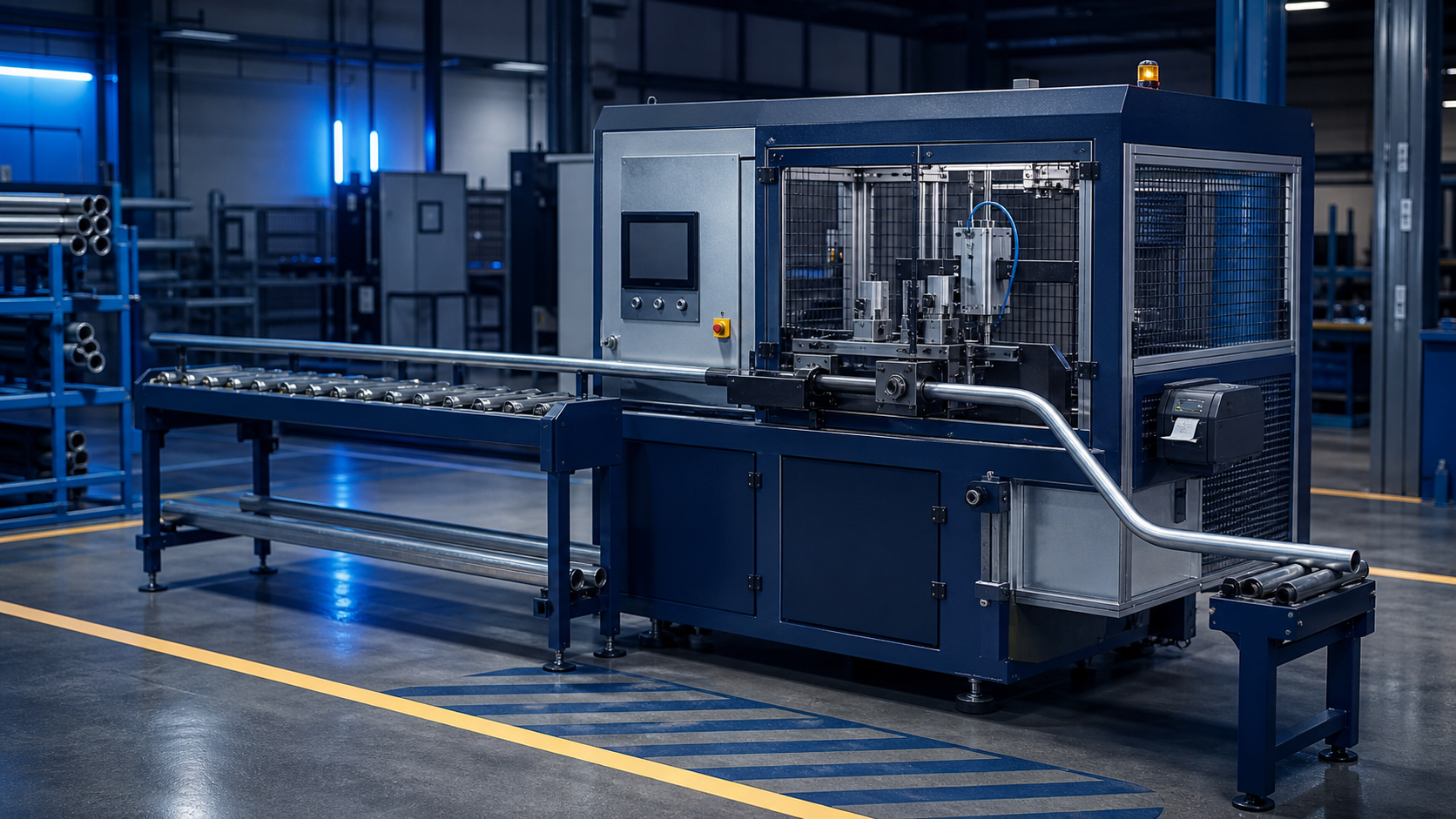
The product identity follows the company brand while the engineering concept stays centered on throughput, repeatability, guarding, traceability, and the operator.
NOT JUST ANOTHER BENDER
Digital benders already establish controlled-angle and repeat-bend capability. A useful AMVUE system must improve more of the contractor’s workflow: identify the material, receive the work order, measure, prepare, feed, rotate, bend, inspect, label, and preserve traceability.
Because AMVUE is still validating the opportunity, the first engagement is a workflow and productivity discovery—not a promise to sell a finished machine. The customer’s real throughput, labor, scrap, layout, safety, and payback conditions decide whether deeper design should proceed.
WHAT WE MEASURE
Jobs per week, conduit types and sizes, bend families, queue time, handling, and floor-space constraints.
First-pass accuracy, rework, scrap, labeling, revision control, inspection, and closeout evidence.
Skill distribution, training time, ergonomic load, guarding, LOTO, supervision, and exception handling.
INITIAL DISCOVERY SCOPE
The design scope remains subject to field evidence, engineering, safety, certification, and freedom-to-operate review.
Repeatable work orders, planned production, controlled layouts, and measurable labor baselines.
High conduit density, repeated assemblies, documentation needs, and schedule pressure.
Centralized preparation supporting multiple crews, floors, or project phases.
Repeatability and traceability needs where material and workflow control can be demonstrated.
MARKET-LED DISCIPLINE
AMVUE is an early-stage company with access to technology, manufacturing, and supply resources. We are presenting focused pathways, listening for real project demand, and building deeper only where customers confirm the need.
Technology leads • Supply reshapes • Talent convergesDESIGN-PARTNER PATHWAY
Observe inputs, tools, labor, layout, output, exceptions, quality checks, and project constraints.
Quantify cycle time, throughput, rework, scrap, handling, training, downtime, and safety conditions.
Define conduit families, sizes, bends, interfaces, operator roles, stop conditions, and acceptance metrics.
Proceed only if verified value, safety, FTO, certification path, support model, and customer commitment justify it.
CONTROL BOUNDARY
Any future prototype or pilot requires machine guarding, electrical and controls review, LOTO procedures, qualified operators, controlled test plans, customer authorization, documentation, and the applicable certification or field-evaluation pathway before use.
CONDUIT PRODUCTIVITY DISCOVERY
We are looking for real contractor workflows, not broad expressions of interest. The strongest starting point is one measurable bottleneck with enough recurring volume to evaluate.
Submitting a discovery request begins a fit review; it is not an equipment order or a promise that a machine is available.